You’re driving a rental car along a narrow coastal road on Crete, stone walls close on one side, a blind bend up ahead. A local car backs out of a driveway and clips your bumper. Nobody is hurt, the damage looks minor, and you are standing on the shoulder trying to work out what happens next in a language you don’t speak.

There is one document that decides whether you get reimbursed for that bumper weeks later, and it is not the one most travelers reach for first. Greece has a specific system for handling accidents like this, built around two different forms, a strict timeline, and a police involvement rule that surprises most visitors. Knowing which steps actually matter — and which ones are just stress talking — makes the difference between a five-minute inconvenience and a holiday-long headache.
The First 60 Seconds: Safety Before Anything Else
Before you think about paperwork, deal with the road itself. Turn on your hazard lights immediately, and if the car can still move and nobody is trapped, pull it to the shoulder or a nearby parking area. Greek roads, especially on the islands, are often narrow enough that a stopped car creates a second hazard on top of the first.
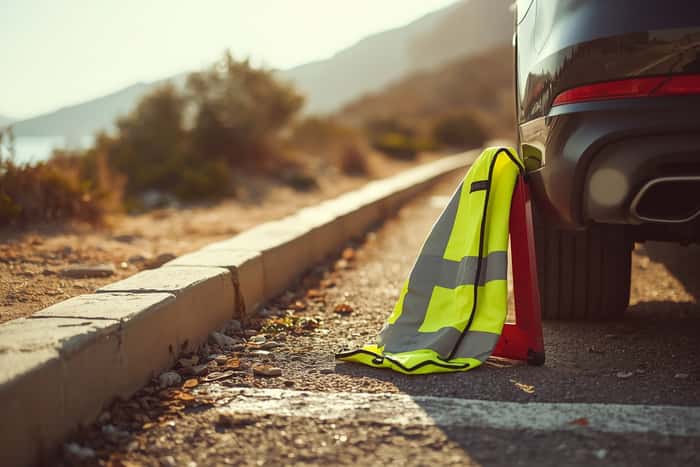
Greek law requires anyone who steps out of a vehicle on the road, day or night, to wear a reflective high-visibility vest. Rental cars are supposed to carry one for each occupant, so check the glovebox or trunk before you get out. It sounds like a formality until you are standing on a dim coastal road at dusk and realize why it exists.
- Turn on hazard lights and move the car if it’s safe to do so
- Put on a high-visibility vest before exiting the vehicle
- Check yourself and any passengers for injuries first, damage second
- Place a warning triangle behind the vehicle if traffic is still passing
- Call 112, the European emergency number, if anyone needs medical help
Once everyone is safe and the immediate danger is handled, the next decision is less obvious than it sounds: whether to call the police at all.
Do You Actually Have to Call the Police?
Contrary to what many travelers assume, Greek law does not require police involvement for every fender-bender. According to the Hellenic Police’s official guidance for drivers involved in a road traffic accident, if there is only material damage and both parties are present and in agreement, you can exchange information directly without waiting for a patrol car.
The moment that changes is injury. If anyone is hurt, however slightly, the police must be called and must record the scene before you leave. The same guidance also requires you to notify the nearest police station within 24 hours if the other party wasn’t present at the time.
This is also where a small number of tourists run into trouble that has nothing to do with the accident itself. In busy tourist corridors, staged fender-benders and pressure tactics from a “helpful” bystander are a known pattern — worth reading about in our guide to car insurance scams while traveling in Europe before you assume every accident is exactly what it looks like.
So if the police aren’t always required, what actually protects you financially when they’re not there?
The Rental Insurance Myth Most Tourists Believe
Here’s where most people get it wrong: the collision damage waiver stamped on your rental agreement does not mean you’re covered for everything. CDW typically caps your liability at an excess amount — often several hundred euros — and it usually excludes damage to tires, the undercarriage, and the windscreen entirely.
This isn’t a Greek quirk; it’s standard across European rental agreements, but it catches visitors off guard because the word “included” on the counter paperwork feels absolute. Before you even book the car, it’s worth understanding what to check before buying car insurance in Greece, since the same excess and exclusion logic applies to private policies too.
Ask the rental desk one direct question before you drive off: what is my excess, and does it drop to zero with the coverage I’ve paid for? If the answer is vague, get it in writing.
That excess amount becomes very relevant the moment you’re filling out paperwork on the roadside — which brings us to the form that actually decides your case.
Statement of Accident vs Friendly Settlement: Which Form Do You Need
This is the document most travelers have never heard of. Greece uses two separate accident forms, and picking the wrong one — or not knowing either exists — is exactly the kind of gap that turns a minor bump into a drawn-out claim.
| Form | When to Use It | Police Needed? |
|---|---|---|
| Friendly Settlement (Φιλικός Διακανονισμός) | Both drivers agree on what happened, only material damage | No |
| Statement of Accident (Δήλωση Ατυχήματος) | Disagreement over fault, any injury, or a driver leaves the scene | Yes |
As outlined in a regional guide to road traffic accidents in Greece, both forms need to capture the same core details — an illustration of the accident, the extent of the damage, and the signatures of both drivers — but they exist for different situations.
Use the Friendly Settlement form when both drivers agree on what happened and the damage is minor: it’s designed to let two insurers settle the claim without a police report. Use the Statement of Accident, and call the traffic police, when there’s disagreement about fault, any injury, or one driver leaves the scene.
- Full name, address and driver’s license number of the other driver
- Vehicle registration number and insurance company name
- Photos of the damage, the position of both vehicles and the road markings
- Names and contact details of any witnesses
What actually matters: If both drivers agree on fault and nobody is hurt, the Friendly Settlement form alone is usually enough — you don’t need to wait for a patrol car to file a valid claim.
Fill in the form together on the spot rather than promising to sort it out later by phone. Once you’re both back in a rental office or at home, memories of who was where get surprisingly unreliable.
Filling out the right form is only half the job — what you do with it in the next 24 hours matters just as much.
Notifying the Rental Company and Your Insurer
Most rental agreements in Greece require you to report an accident to the company within 24 hours, regardless of how minor the damage looks. Miss that window and some companies treat it as grounds to deny a claim outright, waiver or not.
A 2025 guide from Greek rental insurer Ansa recommends contacting the rental company’s roadside assistance line before you even leave the scene, since many providers dispatch someone to assess the damage and handle the paperwork directly.
- A copy of the Statement of Accident or Friendly Settlement form
- Photos of all vehicles involved and the accident location
- The other driver’s insurance details
- The police report reference number, if one was filed
Where most people go wrong: They wait until they’re back home to file the claim. Insurers and rental companies almost always want notification within a day, not a week.
Keep copies of everything on your phone before you hand originals to anyone — a photographed form is better than no form at all.
None of this changes much if the accident was minor. It changes considerably the moment someone is hurt.
If Someone Is Injured, the Rules Change
A twisted ankle from bracing against the dashboard, a sore neck the next morning — these feel minor enough to shrug off on holiday. Greek law disagrees. Any injury, however small, must be reported and recorded at the time, not days later when the soreness sets in.
According to a Greek law firm specializing in traffic accident claims, injured parties should seek treatment at a Greek hospital immediately rather than waiting until they’re home, since a local medical record is what ties the injury to the accident itself.
There’s also a clock running in the background that most visitors never hear about. A criminal complaint against the responsible driver can be filed up to three months after the injured person is able to act, so this isn’t something that needs to be resolved before your flight home — but it does need documentation that starts at the scene.
The paperwork might feel like the least important part of a stressful afternoon. It’s usually the part that decides how the story ends.
You’ll Get Through This, and So Will Your Holiday
An accident abroad rattles people in a way that the same fender-bender back home never would. The language, the unfamiliar rules, the sense that you’re somehow more exposed — all of that is real, and it’s fine to feel shaken by it even when the damage itself is minor.
What tends to settle people fastest is having a plan before it’s needed: know where the high-vis vest is, know which form applies to your situation, know that a 24-hour phone call matters more than getting everything perfect. The rest of your trip through Greece doesn’t have to be defined by twenty stressful minutes on the side of a road.
Frequently Asked Questions
What number do you call for police or an ambulance in Greece?
Dial 112, the European-wide emergency number, which connects you to police, ambulance and fire services and is answered by English-speaking operators in tourist areas.
Do you need to call the police for a small scratch?
Not necessarily. If there’s only material damage and both drivers agree on what happened, you can complete a Friendly Settlement form and skip waiting for a patrol car.
What happens if the other driver doesn’t have insurance?
Insist on calling the traffic police so an official report is filed. Without one, pursuing compensation from an uninsured driver becomes significantly harder.
Can you keep driving the rental car after an accident?
Only if the rental company confirms the car is safe to drive and the damage doesn’t affect your coverage going forward — check with them before continuing your trip.
This article is meant to give you a general sense of how accidents are typically handled in Greece, not a substitute for advice from your insurer, the rental company or a local legal professional who knows the specifics of your situation.